
New Study – In vitro binding energies capture Klf4 occupancy across the human genome
While transcription factors (TFs) bind genomic DNA at specific positions to control gene expression, it is unclear which parameters dictate the low-affinity binding of TFs to non-motif sequences despite their importance.
Can we develop a model to robustly predict transcription factor binding on low-affinity DNA sequences using binding energies?
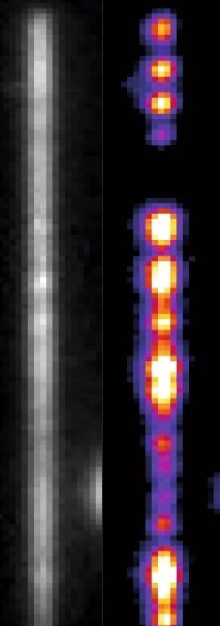
The groups of Hyman, Jülicher, and Grill, principal investigators of the RTG, have published a collaborative study in PNAS to answer this question. Using measurements of physical binding energies of human TF Krüppel-like factor 4 (Klf4) to a library of short DNA sequences, 2 models were combined to map the interactions of Klf4 with nucleotides. The resulting parameters were tested on the “Klf4 binding patterns on an individual long DNA molecule stretched in the optical tweezer”. The importance of this characterisation stems from previous observations that binding to “low affinity sequences enables overall high sequence specificity”. Moreover, the authors also plan to use these parameters to “identify cell types and genomic regions where a prewetting threshold might be locally exceeded, enabling droplet formation and the emergence of transcriptional condensates, as has been reported for Klf4 and related factors in living cells”
Read the full article here: https://doi.org/10.1073/pnas.2538133123
Copyright: Nature Physics (Nat. Phys.) ISSN 1745-2481 (online) ISSN 1745-2473 (print)
From: Force generation by protein–DNA co-condensation
DNA stretched with optical tweezers (left) and transcription factor occupancy (right)