

Alberti and Hyman among Clarivate's Highly Cited Researchers in 2025
RTG 3120 PI's have been among the most highly cited authors in 2025, according to Clarivate, with Hyman and Alberti leading the way "in the top 1% by citations for their field(s) and publication year in the Web of Science Core Collection"
See the press release by TU Dresden: https://tu-dresden.de/tu-dresden/newsportal/news/starkes-zeichen-fuer-die-qualitaet-der-spitzenforschung-13-forschende-der-tud-gehoeren-zu-den-meistzitierten-weltweit?set_language=en
See the full list: https://clarivate.com/highly-cited-researchers/


Agnes Toth-Petroczy receives Schering Young Investigator Award 2025
According to the Schering Stiftung website: "The Schering Stiftung annually awards the Schering Young Investigator Award, honoring scientists who have demonstrated outstanding achievements in basic research across the spectrum of life sciences... It carries a prize money of € 10,000."
Agnes "receives the award for her pathbreaking work on the evolution, diversity, and function of proteins – especially those that have so far been largely unexplored."
Agnes is currently recruiting a PhD student for the project: Sequence to function mapping of condensate proteomes (B3) within the RTG Biomolecular Condensates.

Read more:
https://scheringstiftung.de/en/programm/lebenswissenschaften/young-investigator-award/yia2025/
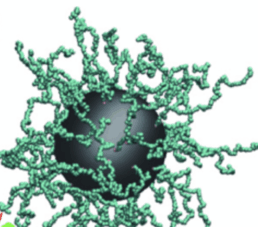
Molecular dynamics investigation of polymer-decorated nanoparticles with co-nonsolvent
A new study by Sommer and colleagues in the Journal of Chemical Physics investigates how polymer-decorated nanoparticles (PDNPs)—tiny particles coated with grafted polymer chains—undergo structural changes in mixed-solvent environments. Using detailed molecular dynamics simulations, the authors of the study entitled "Molecular dynamics investigation of polymer-decorated nanoparticles with co-nonsolvent: Structural transitions from isotropic layers to heterogeneous patches" reveal how the co-nonsolvency (CNS) effect—a phenomenon where adding a small amount of a secondary solvent can change overall solvent quality—induces dramatic transformations in PDNP morphology.
| In good solvents, the grafted polymers form uniform, isotropic “brush-like” layers around the nanoparticle, completely covering its surface. As CNS concentration increases, the solvent becomes poorer, triggering a first-order phase transition in which these smooth polymer coatings collapse into heterogeneous patchy micelles. |
|
|---|
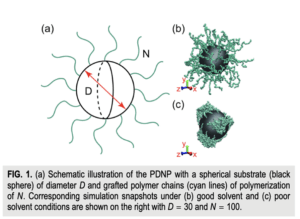
This process is reversible: upon further increasing the better solvent’s proportion, the system undergoes a two-step reentry transition—first restoring angular uniformity and then expanding radially. The researchers use a quantitative descriptor, surface coverage (θ), which measures how much of the nanoparticle surface remains shielded by polymer. Tracking θ provides deep insight into these morphological transitions beyond traditional metrics like brush thickness.
A major finding is that PDNPs on curved (spherical) surfaces respond more sensitively and over broader parameter ranges than planar polymer brushes, making them better suited for practical applications. The simulations further demonstrate that these solvent-controlled structural changes can reversibly regulate the adsorption or exclusion of cargo nanoparticles(CNPs) based on size. Small CNPs can penetrate swollen brushes in good solvents, while larger ones adhere only when the polymer collapses into patches, enabling selective, tunable particle screening.
Impact:
This work provides a mechanistic framework for designing stimuli-responsive nanomaterials that can reversibly change surface properties and selectively interact with other particles—all through minimal solvent adjustments rather than temperature or pH changes. The results have promising implications for drug delivery systems, smart coatings, and nanoscale separation technologies, where environmental control and size-selectivity are critical
Citation:
Cheng-Wu Li, Holger Merlitz, Jens-Uwe Sommer; Molecular dynamics investigation of polymer-decorated nanoparticles with co-nonsolvent: Structural transitions from isotropic layers to heterogeneous patches. J. Chem. Phys. 7 October 2025; 163 (12): 124902. https://doi.org/10.1063/5.0295227
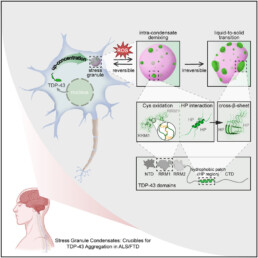
Intra-condensate demixing of TDP-43 inside stress granules generates pathological aggregates
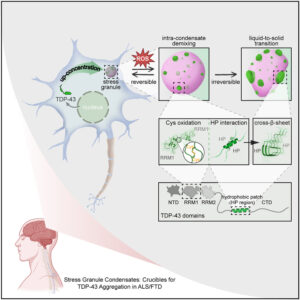
A new study from the labs of Honigmann, Hyman, and Alberti in Dresden, in addition to colleagues in Texas A&M University, Mayo Clinic, Brown University, and Saint Louis University investigates the mechanism behind pathological outcomes of protein aggregation inside stress granules. The authors of the study entitled "Intra-condensate demixing of TDP-43 inside stress granules generates pathological aggregates" and published in Cell in May, 2025, determined that aggregation of TAR DNA-binding protein 43 (TDP-43) is induced by two events, namely up-concentration of TDP-43 in stress granules beyond a threshold and oxidative stress and described the mechanism behind the observation. They use this new understanding to engineer TDP-43 variants resistant to aggregation in the cell.
Impact: The aggregation of TDP-43 in motor neurons is a hallmark of neurodegenerative diseases including amyotrophic lateral sclerosis (ALS). Understanding the mechanisms leading to aggregation paves the path towards developing preventive and therapeutic strategies.
Citation:
Yan, X., Kuster, D., Mohanty, P., Nijssen, J., Pombo-García, K., Garcia Morato, J., Rizuan, A., Franzmann, T. M., Sergeeva, A., Ly, A. M., Liu, F., Passos, P. M., George, L., Wang, S.-H., Shenoy, J., Danielson, H. L., Ozguney, B., Honigmann, A., Ayala, Y. M., Fawzi, N. L., Dickson, D. W., Rossoll, W., Mittal, J., Alberti, S., & Hyman, A. A. (2025). Intra-condensate demixing of TDP-43 inside stress granules generates pathological aggregates. Cell, 188(15), 4123-4140.e4118. https://doi.org/10.1016/j.cell.2025.04.039

Impact of Coiled-Coil Domains on the Phase Behavior of Biomolecular Condensates
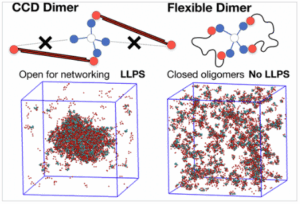
A new Study from the Harmon and Sommer Labs in ACS Macro Letters entitled 'Impact of Coiled-Coil Domains on the Phase Behavior of Biomolecular Condensates' addressed how the geometry and structure of folded domains impact condensate formation. They used coarse-grained simulations to determine that coiled-coil domains (CCDs) promote liquid–liquid phase separation (LLPS), while replacing the CCD with a flexible linker abolishes LLPS. CCDs must have a critical length to promote LLPS at low concentrations.
The results of this study offer a framework for designing synthetic condensates with tunable phase behaviors.
Citation:
Zhouyi He, Jens-Uwe Sommer, and Tyler S. Harmon. Impact of Coiled-Coil Domains on the Phase Behavior of Biomolecular Condensates. ACS Macro Letters 2025 14 (4), 413-419. DOI: 10.1021/acsmacrolett.4c00821

New Research Training Group for Biomolecular Condensates in Dresden
The DFG approved a funding application to establish a new Research Training Group (RTG 3120) in Dresden to train PhD students interdisciplinary methods and approaches to study Biomolecular Condensates. Read the press releases for more:
- https://tu-dresden.de/tu-dresden/newsportal/news/dfg-foerdert-neues-graduiertenkolleg-zur-erforschung-biomolekularer-kondensate-in-dresden
- https://www.mpi-cbg.de/news-outreach/news-media/article/new-research-training-group-for-biomolecular-condensates-in-dresden
Researchers from Dresden and Barcelona reveal how glycolysis drives early embryonic cell decisions
The studies, published in CellStemCell with the participation of RTG 3120 PI Miki Ebisuya, uncover the instructive potential of glycolysis. Read the press coverage and publications for more:
- https://www.embl.org/news/science-technology/metabolism-shapes-life/
- https://www.mpi-cbg.de/news-outreach/news-media/article/metabolism-shapes-life
- Integrated molecular-phenotypic profiling reveals metabolic control of morphological variation in a stem-cell-based embryo model. Cell Stem Cell, 16 April, 2025. https://doi.org/10.1016/j.stem.2025.03.012
- Glycolytic activity instructs germ layer proportions through regulation of Nodal and Wnt signaling, Cell Stem Cell (2025). https://doi.org/10.1016/j.stem.2025.03.011
A quick intro to Complexity
The Earth, which once was a messy ball of melted rock, is now teeming with complex living creatures extraordinarily adapted to their ecosystem. But the second law of thermodynamics tells us that systems spontaneously tend towards disorder and structures states, just like milk tends to mix with coffee. Then, where does complexity come from? Watch this quick intro to Complexity to understand how Nature creates complexity!
Prepared by Mariona Esquerda Ciutat from the Hyman and Jülicher labs in Dresden.
A quick intro to Irreversibility
Have you ever seen a movie backwards in time? How did you figure out that the time was flowing backwards? This could seem a silly question. But think about it. It strongly depends on the what process the movie was showing! If you see many pieces of broken glass coming together from different directions to build a bottle that moves against gravity, you’ll immediately know that the movie is reversed. You know that because breaking a bottle is a very irreversible process. But how would you know it if the movie shows a pendulum? Or two billiard balls colliding? Or a planet orbiting a star? The way we guess the arrow of time on irreversible processes has to do with the Second Law of Thermodynamics! Watch this quick intro to Irreversibility!
Prepared by Mariona Esquerda Ciutat from the Hyman and Jülicher labs in Dresden.
Molecular Assembly Lines in Active Droplets
Cells assemble structures that have lots of molecules. How can such complicated structures be reliably assembled? We propose that cells could be organizing an assembly line process for the construction. We show how this could be organized inside droplets. In this video we explain our recent work published in PRL. Check out the paper for more info: https://journals.aps.org/prl/abstract...
Prepared by Mariona Esquerda Ciutat from the Hyman and Jülicher labs in Dresden.