Restricted content
PhD Seminar Plan
| Date | Speaker (1. Cohort) | Speaker (Extra Cohort) |
|---|---|---|
| 2026 | ||
| May 29th | Nora-Elen Giesinger Theme: 'Molecular insights into condensate surfaces' | Election and seminar planning |
| June 9th | Lukas Haugk Theme: 'Simulation and theoretical modelling of condensates in epigenetics' | Subhasish Chaki Theme: 'Nuclear Condensates as Reaction Containers' |
| June 23rd | Renan dos Reis Theme: 'A Quantitative Framework for Characterising Intracellular Phase Separation in Pluripotent Stem Cells' | Alberto Hernandez Armendariz Theme: 'Emergence of developmental tempo from the organisation of biomolecular condensates |
| July 7th | Snigdha C Udayakumar Theme: 'Core-shell organization in polymer-assisted biomolecular condensates' | Takahiro Yokoyama Theme: 'Phase separation in elastic polymer networks' |
| July 21st | Jishu Dutta Theme: '„Regulation of condensate solvent microenvironment by post-translational modifications of FUS' | Likhitha Pulibandla Theme: '„Exploring how FUS phosphorylation perturbs ATP interactions' |
| October 13th | Zhiheng Zhang | Zhouyi (Joey) He |
| October 27th | Maria del Sol Reyes Ortiz | Dr. Andreas Hartmann |
| December 8th | Vijay Subramanian | Jialin Yin |
| 2027 | ||
| January 19th | Anastasiia Chinakova | Georg Pöppich |
| February 2nd | Daria Miasoedova | Tim Schell-Dieckel |
| February 23rd | Nayantara Varma Parameswaran | Mari Hambardzumyan |
Internal RTG Resources
When preparing your personalised training plan, we recommend that you select from the below list of courses which ones you would like to attend, communicate it to rtg3120@tu-dresden.de, and add it to your supervision agreement. You can of course attend other courses on campus, but do let us know which.
The time and location of the courses (grouped by Program) in the upcoming Winter Semester 2026-27 can be found in the PDF documents linked below:
- Specialisation Physics Bachelor and Master (Soft Condensed Matter and Biological Physics)
- Physics of life (first semester)
- Physics of life (third semester)
- Molecular Bioengineering (first semester)
- Molecular Bioengineering (third semester)
- Regenerative Biology and Medicine (first semester)
- Regenerative Biology and Medicine (third semester)
(need more details on these and other master’s programs? visit it’s main webpage hier)
Please communicate which courses you plan to take to rtg3120@tu-dresden.de
*SWS: Semesterwochenstunden (Number of weekly hours)
| Term | Course Title | Topics | Lecturer(s) | ECTS points / SWS* |
|---|---|---|---|---|
| Winter Semester (WiSe) | Introductory Biological Physics (Part of MSc program Physics of Life) | - Physics for Biology - Polymer physics | Benjamin Friedrich Helmut Schießel Jens-Uwe Sommer | 8 / 6 |
| Winter Semester (WiSe) | Physical Chemistry and Experimental Methods (Part of MSc program Physics of Life) | - Experimental Biophysical Methods - Physical Chemistry of Biomolecules | Michael Schlierf Elisabeth Fischer-Friedrich | 10 / 8 |
| Winter Semester (WiSe) and Summer Semester (SoSe) | Molecular Biology and Biochemistry of Cells and Tissues (Part of MSc program Physics of Life) | - Molecular Biology and Biochemistry of Cells and Tissues - Cell- & Mechanobiology | Simon Alberti | 14 / 4 |
| Winter Semester (WiSe) | Statistical Principles and Experimental Design (Part of MSc program Physics of Life) | - Statistical Principles and Experimental Design - Biodata analysis and Statistics | Ingo Röder | 5 / 4 |
| Summer Semester (SoSe) | Advanced Biological Physics (Part of MSc program Physics of Life) | - Stochastic Processes - Advanced Biological Physics | Benjamin Friedrich Helmut Schießel | 10 / 8 |
| Summer Semester (SoSe) | Experimental Biological Physics: module Applied Biophysics (Part of MSc program Physics of Life) | 6 / 2 | ||
| Summer Semester (SoSe) | Theoretical Biological Physics: module Computational Biophysics (Part of MSc program Physics of Life) | 6 / 2 | ||
| Winter Semester (WiSe) | Pattern Formation and Active Matter Hydrodynamics (Part of MSc program Physics of Life) | - Pattern formation in Biology - Active Matter and Hydrodynamics | Stephan Grill Frank Jülicher Ricard Alert Rita Mateus Carl Modes Otger Campàs | 10 / 8 |
| Winter Semester (WiSe) | Experimental Biological Physics: module Advanced Biophysics (Part of MSc program Physics of Life) | 6 / 2 | ||
| Winter Semester (WiSe) | Theoretical Biological Physics: module Advanced Theoretical Biophysics (Part of MSc program Physics of Life) | 6 / 2 | ||
| Summer Semester (SoSe) and Winter Semester (WiSe) | Soft Condensed Matter and Biological Physics (part of Master in Physics) | -Computer simulation of soft condensed matter -Nanotechnology - Introduction to Soft Condensed Matter Physics -Symmetry Breaking in Condensed Matter Physics - Cellular Machines - Colloids and Interfaces - Stochastic Processes - Advanced biological Physics - Physical Measurement in living systems - Biological Thermodynamics | Jens-Uwe Sommer Helmut Schießel Benjamin Friedrich Elisabeth Fischer-Friedrich Karim Fahmy Stefan Diez Andreas Fery Günter Auernhammer Lukas Eng Rajib Sarkar | |
| Winter Semester (WiSe) | The physics and biology of Biomolecular Condensates | Adams, Hubatsch and Schiessel | # / 4 | |
| Nr. | Date | Topic |
|---|---|---|
| 1 | October 15th | Introduction to Research Data Management |
| 2 | October 22nd | Research Data Lifecycle & FAIR data |
| 3 | October 29th | (Meta)data: Planning, Organizing and Documenting |
| 4 | November 5th | (Meta)data: Storing, reusing and Publishing |
| 5 | November 12th | Examples of a Data Life Cycle in a wet lab group |
| 6 | November 19th | Review and refine data management plans part 1 |
| 7 | November 26th | How to document research experiments, its data and metadata |
| 8 | December 3rd | AI tools in research |
| 9 | December 10th | Data publication in public repositories: OPARA, OMERO, Zenodo and Co. |
| 10 | December 17th | Examples of a Data Life Cycle in a computational group |
| 11 | January 14th | Data curation, ontologies, and knowledge Graph Databases |
| 12 | January 21st | Developing predictive tools with machine learning and AI |
| 13 | January 28th | Review and refine data management plans part 2 |
| Date | Speaker | Topic | Slides |
|---|---|---|---|
| 05.05.2026 | Patrick McCall | Contrasting phases: from biomolecular composition to condensate properties and functionality | Download |
| 12.05.2026 | Kick-Off Symposium | RTG Overview | Download |
| 19.05.2026 | Lars Hubatsch | Transport Kinetics Across Phase Boundaries | |
| 02.06.2026 | Arash Nikoubashman | Molecular insights into biomolecular condensates from coarse-grained simulations | |
| 16.06.2026 | Alexander von Appen | Building a minimal nucleus to understand structure and mechanics of assembly | |
| 30.06.2026 | Jared Sterneckert | New insights into axonal vulnerability to ALS using iPS cells | |
| 17.07.2026 | Evan Spruijt | ||
| 06.10.2026 | Aida Maraj | ||
| 27.10.2026 | Amy Gladfelter | ||
| 10.11.2026 | Host: Miki Ebisuya | ||
| 17.11.2026 | Agnes Toth-Petroczy | ||
| 24.11.2026 | Sebastian Aland | ||
| 01.12.2026 | Ellen Adams | ||
| 15.12.2026 | Tony Hyman | ||
| 12.01.2027 | Jan Brugues | ||
| 26.01.2027 | Helmut Schiessel |
| Speaker(s) | video and slides | Topic(s) | Date |
|---|---|---|---|
| Simon Alberti | Video - Slides | Biochemistry of higher-order assemblies and condensates | 07.05.2026 |
| Alf Honigmann | Video - Slides | Role of protein phase separation for organization of cellular membranes | 07.05.2026 |
| Helmut Schiessel | Video - Slides | The physics of epigenetics | 21.05.2026 |
| Jan Brugues | No Recording | Chromatin organization by condensate-DNA interactions | 21.05.2026 |
| Anthony Hyman | Audio No video Recording | Phase Separation in Cell Physiology and Disease | 28.05.2026 |
| Michael Schlierf | Slides No Recording | RNA biology and RNA folding in the context of condensates | 04.06.2026 |
| Jens-Uwe Sommer | Video (Low audio quality) | Multi-component phase transitions | 11.06.2026 |
| Jared Sterneckert | Video - Slides | Amyotrophic lateral sclerosis: from disease mechanisms to therapeutics | 18.06.2026 |
| Titus Franzmann | No recording available | An introduction to Protein folding | 25.06.2026 |
| Ellen Adams and Tyler Harmon | No recording available | - Water in biological systems -Molecular grammar underlying biological condensation | 02.07.2026 |
| Agnes Toth-Petroczy and Miki Ebisuya | No recording available | - Evolution of condensates - n vivo Models for studying the Kinetics of Condensates | 09.07.2026 |
| Stephan Grill | No recording available | Biomolecular condensates on and with DNA | 16.07.2026 |
Guides for your PhD time in Dresden
Starting your PhD with RTG 3120
Admission to the Research Training Group 3120 (RTG 3120) is granted by the Spokesperson of the RTG 3120 following the recommendation of RTG Principal Investigators. In General, the PhD student is allocated to one research group. However, students in tandem projects (B1 or B5) are additionally integrated into activities of the partner research group. In case a group leader moves to another affiliation, the PhD student concerned may remain a member of the RTG 3120 for the entire duration of the thesis.
Change of group or termination of participation in the RTG should be approved by the Spokesperson in agreement with the RTG Principal Investigators.
Admission to the RTG 3120 requires the provision of certified documentation of the university degrees as stated in the application (i.e. degrees awarded and degrees anticipated at the time of the application) upon start of the PhD thesis work.
PhD Students are required to register at the responsible faculty of the Dresden University of Technology (TUD) for their PhD (See next section “first steps”)
- Sign the contract with TUD, Max Planck, or Leibniz
- activate your ZIH account:
- If you are employed at TUD, activate your ZIH account using the coupon received during contract signing.
- If you are employed by another Institution (i.e. Max Planck Institute, Leibniz IPF) then you will receive an invitation to set up a guest ZIH account from the coordinator to activate it
- Submit the application document for the admission as doctoral candidate
- Register on Promovendus: https://promovendus.tu-dresden.de/home
- Filll out the forms with contact information and details about your former degrees, making sure to select RTG 3120 in the doctoral program section, and upload your certificates and transcripts, CV, and signed supervision agreement (https://tu-dresden.de/ga/ressourcen/dateien/mitgliedschaft/mitgliedschaftsdokumente/Supervision_Agreement.pdf?lang=en )
- Print out and sign the forms, in addition to signature of supervisors
- Submit the forms in person to the Doctoral Examinations Office of your faculty
- Once approval is received, you can now enrol at TUD (Matriculation)
- Matriculation: Prerequisite for Matriculation as a doctoral student is the acceptance as a doctoral student by the Doctoral Committee of the faculty at which you wish to do your doctorate.
- Login with ZIH account to Selma Portal: https://selma.tu-dresden.de/APP/EXTERNALPAGES/-N000000000000002,-N000511,-ABUZ_welcome_extern_en
- Click on Application and Current Applications, answer the three questions:
- What kind of studies are you applying for?*
- What is your citizenship?*
- What kind of university entrance qualification do you have?*
- Click Save
- Click on Start Application
- Under Subject select your faculty (e.g. Physics or Biology) and under Degree Type select ‘Doctorate’ then click search
- Select your subject from the list (e.g. Biology) and then click on Apply.
- Make sure to save the application number (e.g BW-######) and fill in the sections individually (starting with ‘Selected degree programme’) then submit.
- Click on Health Insurance Data, Edit, and fill in the form, and save
- Pay semester fee
- Receive campus card in regular mail (use for public transport and eating in the student Mensa)
All students receive a working contract in the E13 salary group from their main affiliation (TUD, MPI-CBG, Leibniz IPF). Contracts are taxed, and contributions to health insurance, pension scheme, and social benefits are automatically deducted from the income before it is transferred to your back account. Contracts can be offered for up to 4 years, but can differ in duration on case by case basis depending, for example, on the validity of your visa / residence permit or policies of the hiring institution.
The maximum duration of stay is 4 years. Students finishing earlier can apply for start-up funding to support them financially while applying to postdoc positions or wrapping up projects and publications.
Ideally, the committee consists of 3 principal investigators, one from the research area A (Physics Focus) and one from research area B (Biology Focus), and a third you choose together with your main supervisor. This needs to be documented in the supervision agreement provided to you during admission and signed by you and all members of the committee. A schedule will be provided to you containing the deadlines for submitting reports to the TAC and till when the TAC meetings should take place. Before each TAC meeting, the report with your current progress should be submitted to the committee 1 week at the latest to the committee members and to rtg3120@tu-dresden.de. The templates for the TAC meetings can be downloaded from the following links and will be sent to you directly 4 weeks before the deadline.
Thesis Advisory Committee (TAC) Report Template
Select your contract start date to download the correct TAC report template
The structured nature of the research training group offers many opportunities, but also responsibilities of all participants. Therefore, the following list highlights the most important, but not all, duties to be fulfilled towards the RTG in order for the program to fulfil its mission.
- Inform yourself about TUD regulations on enrolment and graduation
- Apply for acceptance as a doctoral student and enrolment (Matriculation) at TUD in the respective faculties
- Attend and actively participate in organised teaching and training events (curriculum)
- Present project plans and results (in PhD Seminars, Retreats, TAC meetings)
- Submit TAC reports and organise TAC meetings in a timely manner
- Inform the RTG coordinator about
- publications of research done in connection with the RTG
- relevant dates of doctoral proceedings at TUD after thesis submission
- change of contact information, desk/bench location, or contractual conditions (pregnancy, parental leave, prolonged sick leave etc)
- circumstances that may cause the student to terminate their affiliation to the program prematurely.
- initiate doctoral proceedings at the faculty and complete thesis within forseen duration
- Submit of a bound copy of the thesis to the RTG coordinator
- complete the leaving questionnaire upon fulfilling all RTG requirements, including (tentative) future plans
Two students will be elected on an annual basis to volunteer in representing RTG students in the RTG committees (Teaching committee, Research Data management, and general assembly). It’s a chance to learn more about the inner workings of the research enterprise, bring forward the suggestions of peers, and improve communication, organisation, and argumentation skills.
The next election takes place on May 29th, 2026. Daria and Anastasiia have volunteered as candidates.
Matriculation at TU Dresden automatically registers you at the graduate academy, a unit of TU Dresden that provides soft skills and career training. One of the most important training components they provide is Good Scientific Practice. You will be informed about the date and location of that training and others by E-mail. You can additionally subscribe to the RTG Calendar to see details of all upcoming events.
With acceptance of the position at the RTG 3120, you agree to:
- the publication of first name, last name, group, institutional affiliation and E-mail, year of graduation and title of thesis project
- the collection of personal and academic information in an internal database in order to administer the student’s progress within RTG and report to the funding agency (DFG)
After completion of the RTG requirements, including thesis submission within 4 years, and a successful thesis defence, a certificate is issued by the RTG to acknowledge the successful participation in the program and detailing the completed requirements.

Seminars & Lectures
RTG Seminars and Lectures
As a core component of the structured training in RTG 3120, Research Seminars and Ring Lectures will feature leading scholars and scientists in the field in Dresden and from abroad to share the latest research from their groups and community. All researchers in Dresden working or interested in the field are invited to join the seminars. The variety of disciplines covered by the speakers will showcase the interdisciplinary approaches in studying condensates and prepare the PhD candidates of the RTG for a stimulating scientific career.
Research Seminar
The Research Seminar takes place every other Tuesday at 12 starting May 2026 and presents the audience with insights into the frontiers of condensates research. The list below is tentative and maybe changed at any time. Therefore, please consult the page regularly for updates.
| Speaker | Affiliation | Topic | Date | Location |
|---|---|---|---|---|
| Patrick McCall | Leibniz Institute for Polymer Research Dresden | Contrasting phases: from biomolecular composition to condensate properties and functionality | 05.05.2026 | CRTD |
| Lars Hubatsch | MPI-CBG Dresden | Transport Kinetics Across Phase Boundaries | 19.05.2026 | CRTD |
| Arash Nikoubashman | Leibniz Institute for Polymer Research Dresden | Molecular insights into biomolecular condensates from coarse-grained simulations | 02.06.2026 | CRTD |
| Alexander von Appen | MPI-CBG Dresden | Building a minimal nucleus to understand structure and mechanics of assembly | 16.06.2026 | B CUBE |
| Jared Sterneckert | CRTD, TU Dresden | New insights into axonal vulnerability to ALS using iPS cells | 30.06.2026 | CRTD |
| Evan Spruijt | Radboud University Nijmegen, The Netherlands | Condensates in contact with membranes | 14.07.2026 | CRTD |
| Aida Maraj | MPI-CBG, Dresden | 03.11.2026 | B CUBE | |
| Tugce Aktas | MPI-MolGen, Berlin | 10.11.2026 | B CUBE | |
| Amy Gladfelter | Duke University School of Medicine | 17.11.2026 | B CUBE | |
| Sebastian Aland | HTW Dresden | 24.11.2026 | B CUBE | |
| Ellen Adams | Physics of Life, TU Dresden | 01.12.2026 | B CUBE | |
| Tony Hyman | MPI-CBG Dresden | 15.12.2026 | B CUBE | |
| Jan Brugues | Physics of Life, TU Dresden | 12.01.2027 | B CUBE | |
| Helmut Schiessel | Physics of Life, TU Dresden | 26.01.2027 | B CUBE |
Ring Lecture
The Ring Lecture takes place every Thursday at 16:40 in the summer semester of 2026, 2027 and 2028 and is dedicated to teach early career researchers the principles of condensates science and landmark research studies. The list below is tentative and maybe changed at any time. Therefore, please consult the page regularly for updates.
| Speaker(s) | Affiliation | Topic(s) | Date | Location |
|---|---|---|---|---|
| Simon Alberti and Alf Honigmann | BIOTEC, TU Dresden | -Biochemistry of higher-order assemblies and condensates - Role of protein phase separation for organization of cellular membranes | 07.05.2026 | MPI-CBG |
| Helmut Schiessel and Jan Brugues | Physics of Life, TU Dresden | -The physics of epigenetics -Chromatin organization by condensate-DNA interactions | 21.05.2026 | MPI-CBG |
| Anthony Hyman | MPI-CBG Dresden | Phase Separation in Cell Physiology and Disease | 28.05.2026 | Leibniz IPF Dresden |
| Michael Schlierf | B CUBE, TU Dresden | RNA biology and RNA folding in the context of condensates | 04.06.2026 | MPI-CBG |
| Jens-Uwe Sommer | Leibniz IPF Dresden | Multi-component phase transitions | 11.06.2026 | MPI-CBG |
| Jared Sterneckert | CRTD, TU Dresden | Amyotrophic lateral sclerosis: from disease mechanisms to therapeutics | 18.06.2026 | MPI-CBG |
| Titus Franzmann | BIOTEC, TU Dresden | An introduction to Protein folding | 25.06.2026 | BIOTEC |
| Ellen Adams and Tyler Harmon | Physics of Life, TU Dresden Leibniz IPF Dresden | - Water in biological systems -Molecular grammar underlying biological condensation | 02.07.2026 | MPI-CBG |
| Agnes Toth-Petroczy and Miki Ebisuya | MPI-CBG Dresden Physics of Life, TU Dresden | - Evolution of condensates - in vivo Models for studying the Kinetics of Condensates | 09.07.2026 | MPI-CBG |
| Stephan Grill | MPI-CBG Dresden | Biomolecular condensates on and with DNA | 16.07.2026 | MPI-CBG |
PhD Seminar
The PhD Seminar is forum for presenting project ideas and work in progress between students and affiliates of the RTG 3120. Two scientists, one from the primary cohort and one from the extra cohort, are asked to present and discuss their work in around 30 minutes each (aim for 15 minutes of material to present). The focus should be on clearly explaining the background, context, scientific gap/question, aims, methods, and if available preliminary results to an interdisciplinary audience. This event of the RTG aims to support the training of RTG students into interdisciplinary scientists well-trained and versed in physics, biology, and biochemistry to bridge these fields and address biological phenomena that require a wide range of expertise.
| Date | Speaker (1. Cohort) | Speaker (Extra Cohort) |
|---|---|---|
| 2026 | ||
| May 29th | Nora-Elen Giesinger Theme: 'Molecular insights into condensate surfaces' | Election and seminar planning |
| June 9th | Lukas Haugk Theme: 'Simulation and theoretical modelling of condensates in epigenetics' | Subhasish Chaki Theme: 'Nuclear Condensates as Reaction Containers' |
| June 23rd | Renan dos Reis Theme: 'A Quantitative Framework for Characterising Intracellular Phase Separation in Pluripotent Stem Cells' | Alberto Hernandez Armendariz Theme: 'Emergence of developmental tempo from the organisation of biomolecular condensates |
| July 7th | Snigdha C Udayakumar Theme: 'Core-shell organization in polymer-assisted biomolecular condensates' | Takahiro Yokoyama Theme: 'Phase separation in elastic polymer networks' |
| July 21st | Jishu Dutta Theme: '„Regulation of condensate solvent microenvironment by post-translational modifications of FUS' | Likhitha Pulibandla Theme: '„Exploring how FUS phosphorylation perturbs ATP interactions' |
| October 13th | Zhiheng Zhang | Zhouyi (Joey) He |
| October 27th | Maria del Sol Reyes Ortiz | Dr. Andreas Hartmann |
| December 8th | Vijay Subramanian | Jialin Yin |
| 2027 | ||
| January 19th | Anastasiia Chinakova | Georg Pöppich |
| February 2nd | Daria Miasoedova | Tim Schell-Dieckel |
| February 23rd | Nayantara Varma Parameswaran | Mari Hambardzumyan |

Training Program
Training and Supervision
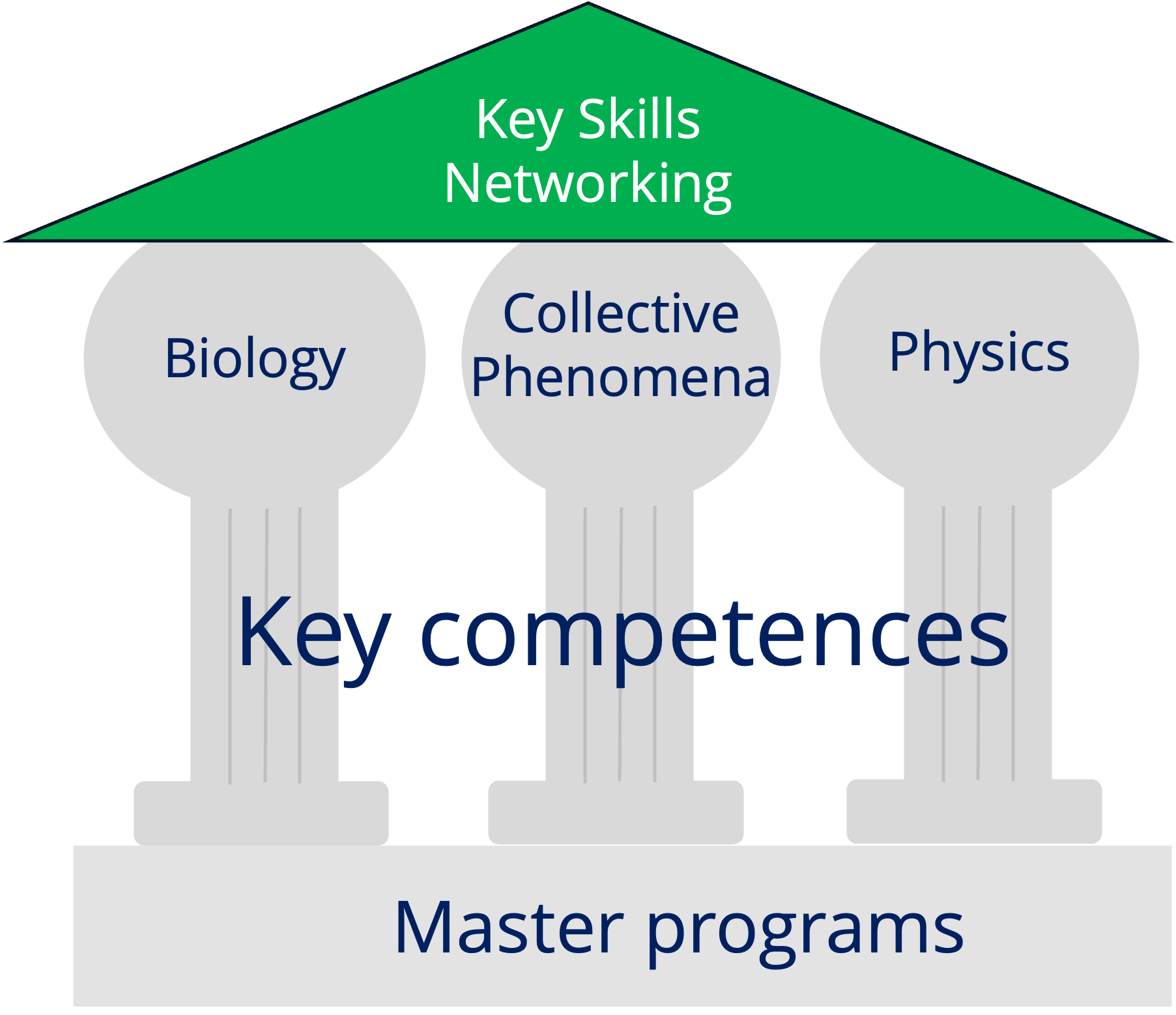
The structured training program of RTG 3120 will enable PhD candidates to take interdisciplinary approaches in studying condensates, clearly communicate with scientists from other fields, and prepare for a stimulating scientific career. From onboarding and individualised research and training plans, to seminars, lab rotations, retreats, and thesis writing: RTG 3120 PIs will guide the students every step of the way and offer close supervision and mentoring. You can also consult the DFG website for PhD students that explains what a research training group is and what to expect.
A high degree of interdisciplinary knowledge is required in order to achieve breakthroughs in the field of biomolecular condensates including soft matter and polymer physics, biophysics, biochemistry, cell biology, and computational biology. While a high level of disciplinary excellence is necessary for the students to be successful in their respective fields, the interdisciplinary training will enable students to take immediate advantage of the progress in the other relevant research fields from understanding the reasoning and research strategies in these fields.
Leading experts in the field will present lectures and supervise seminars and lab-courses in the framework of a structured interdisciplinary teaching program ranging from theory to hands-on-training. We will also incorporate training on non-scientific skills and foster personal development towards successful careers in science, industry, and education.
The training and development of students is further complemented through close mentoring and structured supervision by experts from various disciplines to nurture interdisciplinary and collaboration.
Goals of the training program
- Achieve a high level of disciplinary qualification in the corresponding fields (theory/simulations, experimental biophysics, biochemistry, cell biology)
- Enable students to integrate insights and methods of other disciplines through communication to promote an understanding of their research culture
- Foster scientific and professional independence by giving students responsibilities for organizing seminars, retreats, and workshops
- Build a professional network through conferences and research stays
- Encourage students to plan their own research as well as guide master and bachelor students to develop transferable soft skills
- Ensure a mastery of managing research data according to the FAIR principles and ethical considerations.
- Acquire knowledge of tools and concepts of machine learning and artificial intelligence in science.
Program Elements
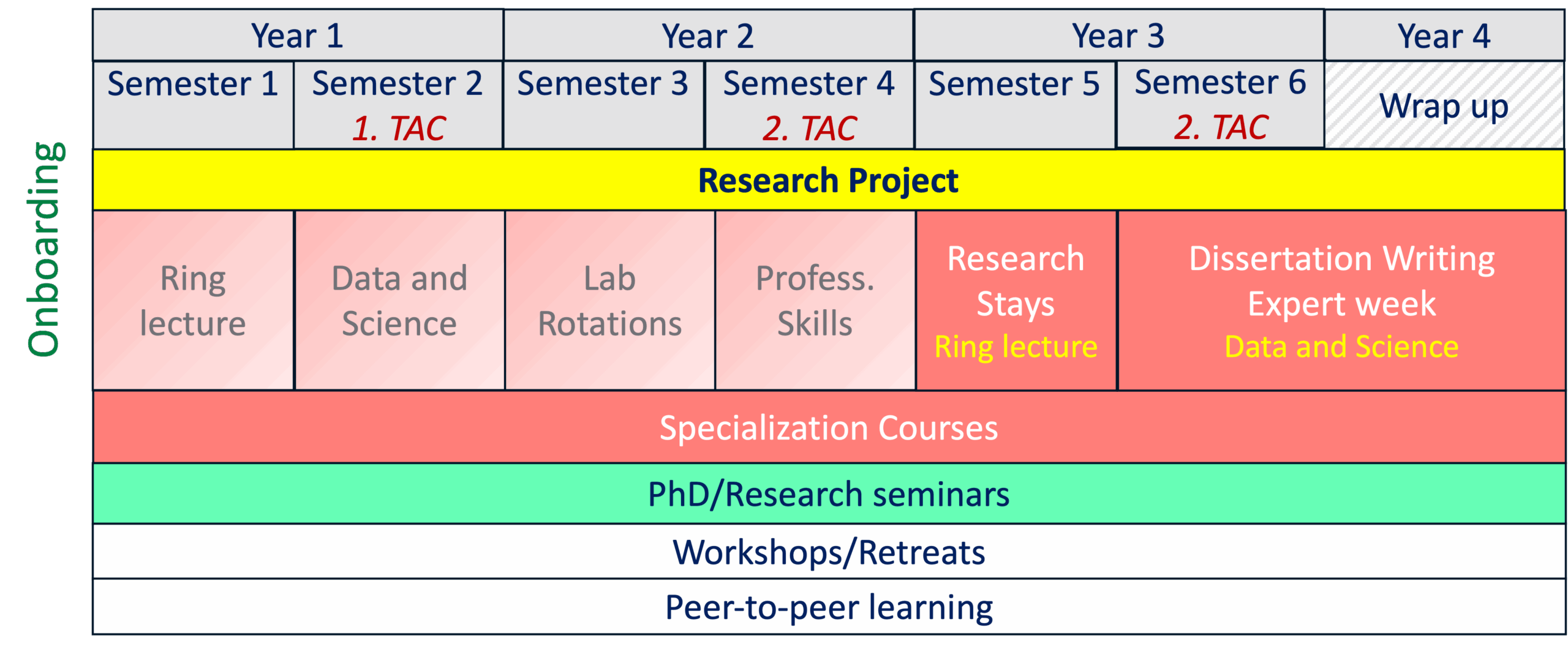
The German Term “SemesterWochenStunden” or SWS refers to hours per week in the lecture period of the semesters. for example, 2 SWS are 2 hours per week in the lecture period of the semesters. there are 2 Semesters in an academic year in Germany: Winter and Summer Semesters.
Onboarding will ensure a smooth start for students by equipping them with the knowledge and tools they need to kickstart their doctoral journey.
During the first weeks of starting, the students will be guided through completing the paperwork for the university and local authorities, establishing their work spaces, and preparing their individualized training and research plans. This phase will also include workshops on good scientific practice, basics of data management, using the electronic lab notebooks, and preparing the doctoral supervision agreement. The onboarding will be completed with a Kickstarter gathering where students introduce themselves and the thesis project they will lead and receive feedback from their colleagues. This will prepare the students for the initial Thesis Advisory Committee (TAC) meeting where their research and training plans are formalized.
The core qualification for each PhD student. The goal is to master the skills and qualification in the respective discipline, in addition to a developing interdisciplinary thinking and interdisciplinary collaborations. The projects will be supervised by experts in the discipline and co-supervised by PIs from complementary project areas.
Individual didactic lectures given by the participating group leaders and invited external speakers throughout the semester. Topics introduced cover basics in the respective fields of the lecturers and can go beyond the scope of biomolecular condensates.
A weekly lecture in the second semester introducing basic concepts including machine learning tools and introductions at on-site facilities to manage research data according to the FAIR principles and according to good scientific practice.
A full week will be blocked for an individualized Lab rotation in an experimental, theoretical, or simulation setting. Students will receive practical insights into complementary techniques without having prior experience in using these tools. The choice and number of rotations is determined during the onboarding phase and are incorporated into the individual training plan.
The specialization courses are taught throughout the PhD in a 2-year cycle. At least two are to be selected from a broad range of courses taught by the participating researchers and other lecturers at the TUD. In a mix of didactic lectures and interactive seminars, core knowledge and methods to study biomolecular condensates are taught from various disciplinary perspectives. The courses aim to provide deep and expert disciplinary knowledge, in addition to ensuring biologists and physicists can understand and can utilise the physical principles and the biological phenomena and functions, respectively. The courses are chosen during the onboarding phase and are incorporated into the individual training plan.
The Research and PhD Seminars alternate every week. RTG PIs and visiting scholars present in the research seminar the latest advancements in the field of condensates. At the PhD Seminar, students either present progress in their projects, give rehearsal talks for conferences, or hold Journal-club-style reviews of new developments in the field.
In cooperation with TU Dresden’s Graduate Academy, training will be offered with respect to planning and project management, scientific writing and publishing, presentation skills, fellowship writing, and leadership.
Join Us

Why Dresden?
“Top-notch scientists from all over the world come to Dresden to conduct research together — Dresden itself is a condensate that crucibles amazing science.”
Zhouyi He, PhD student of the Harmon Group
We offer
12 PhD Student positions starting April 1, 2026, until March 31, 2030, across 12 collaborative thesis projects covering a wide range of approaches — from theoretical physics, to experimental biophysics and biochemistry, and, to cell and molecular biology involving data science.
- Full funding: Up to 4-year PhD positions on TV-L E13 contracts
- Interdisciplinary training: in polymer physics, theoretical physics, biophysics, physical chemistry, cell biology, biochemistry, computational biology with access to advanced research infrastructure and shared core facilities
- Structured PhD program: foundational courses, advanced skills, cutting-edge methods
- Career development: close supervision, mentoring, and guidance for academic and non-academic paths
- Research excellence: publish groundbreaking work at the interface of physics and biology in a vibrant and collaborative scientific community in Dresden and internationally
Each PhD project is embedded in an interdisciplinary framework that includes shared training activities, supervision by interdisciplinary thesis advisory committees, and opportunities for international collaboration.
How to Apply
We’ve outlined the steps you need to take below. If you have general questions about the application procedure, email rtg3120@tu-dresden.de. For specific questions about a specific project, email the corresponding group leader and CC rtg3120@tu-dresden.de. You can also consult the DFG website for PhD students that explains what a research training group is and what to expect.
Explore the thesis projects, the science behind them, and the collaborative networks that will drive those projects to completion. Don’t be shy about contacting the group leaders directly if you need more details about the project, lab, or host institute. In addition, learn about our training and supervision concept that will make this journey worth your while.
- Do hold or anticipate to receive a Master’s degree before taking up the PhD thesis work in life, natural, or material sciences?
- Do you have previous research experience and an outstanding academic record?
- Are you proficient in written and spoken English?
- Are you committed to interdisciplinary research and willing to pursue demanding projects?
If you check all those boxes, then proceed to starting an application.
We recommend preparing the required documents and combining them to one PDF before initiating the application form. We also recommend contacting your supervisor, mentor, or referee and ask them to prepare and send a recommendation/reference letter before the deadline directly via TUD SecureMail Portal https://securemail.tu-dresden.de to rtg3120@tu-dresden.de .
Documents should include:
- A cover letter elaborating on your motivation to join the RTG and primary project of interest (you may indicate interest in up to two alternative projects)
- A curriculum vitae (including explanation for gaps, if any)
- University transcripts and degree certificates (or an official letter from the university confirming that you will complete your studies before starting the PhD studies)
- A list of relevant academic achievements or publications (if applicable), with full citations, indicating and your role in the study (data collection, writing, etc), publication review status (Peer-reviewed or not), and type (original, review, abstract, preprint, dataset, etc). Include also a list of conferences attended with date, location and type of your own contribution (poster, talk)
When ready, proceed to filling in the application form online.
Follow this link to carefully read the call for applications and instructions to apply, and then fill the form and upload the required documents as one PDF before submission. Please note that after submission you will not be able to change any of the given data anymore.
Only if the you face technical difficulties accessing the online form, a PDF copy of the application form can be downloaded here and submitted will all required documents as a single PDF via TUD SecureMail Portal https://securemail.tu-dresden.de to rtg3120@tu-dresden.de .
After the deadline, the RTG members will select the most promising applicants and inform them in writing tentatively within the first week of November. You might consider preparing for your interview by exploring our publications and resources while you wait for an evaluation of your application.
Short-listed applicants will be invited to an online interview starting the second week of November through December. The interviews give the applicants a chance to meet their prospective group leaders, ask questions, and to present themselves, their research experience, and their motivation to join us in Dresden.
While the RTG members evaluate the applicants’ performance during the interviews, the applicants can look into visa requirements (if any) to move to Germany, read about the latest research on biomolecular condensates coming out of Dresden, or simply enjoy the holidays 🙂
After the conclusion of interviews and evaluations, the offers will be sent to the selected applicants starting January 2026 in writing which will include the affiliation to a defined research group. Applicants will be asked to accept the offer within 2 working days in order to proceed as quickly as possible with the preparations for moving to Dresden, for paperwork with the authorities and with the respective research entities.